
Common Misconceptions About Chiropractic Care (Debunked)

After more than 20 years practicing in Tampa, I’ve heard just about every misconception about chiropractic care you can imagine. “Isn’t it dangerous?” “You’re not a real doctor, right?”.
I get it. When you’re considering any healthcare treatment, especially one you’re unfamiliar with, skepticism is healthy. You should ask questions. You should want real answers.
The problem is that much of what people “know” about chiropractic care comes from outdated information, misunderstandings, or stories that have been passed around until they bear little resemblance to reality. Let’s set the record straight on the most common myths I hear – with facts, not defensiveness.
Myth #1: Chiropractors Are Not “Real” Healthcare Professionals
This is probably the most frustrating misconception – because it’s so far from the truth.
Education and licensing requirements: To become a Doctor of Chiropractic (DC), we complete a rigorous four-year doctoral program that includes anatomy, physiology, neurology, radiology, diagnosis, and clinical sciences. That’s after completing undergraduate prerequisites. Total education? Seven to eight years minimum.
National and state regulation: Every chiropractor must pass demanding national board examinations and maintain state licensure with continuing education requirements. We’re regulated healthcare professionals, just like physicians, dentists, and physical therapists.
Our role within the healthcare system: Chiropractors are portal-of-entry providers, meaning patients can see us directly without a referral. We diagnose, treat, and when necessary, refer to other specialists. We work within – not outside – the established healthcare system.
Myth #2: Chiropractic Adjustments Are Unsafe
The safety record of chiropractic care speaks for itself and it’s excellent.
Comparison to other conservative treatments: Research by Dr. Cassidy and colleagues, published in Spine, found that serious adverse events from chiropractic care are exceedingly rare – far lower than risks associated with common pain medications or surgical interventions.
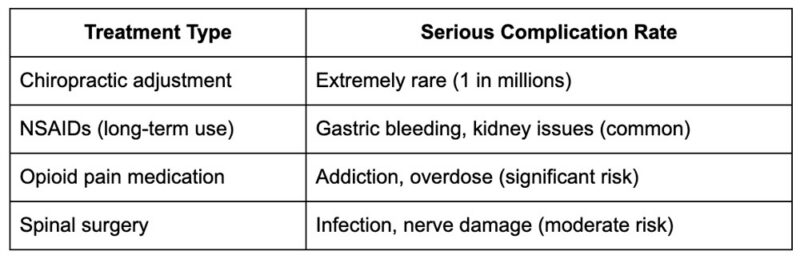
Patient screening and referrals: Before any treatment, we conduct thorough examinations and take imaging when necessary. If we identify conditions that aren’t appropriate for chiropractic care, we refer patients to the right specialist. Safety isn’t accidental – it’s built into everything we do.
Gentle techniques in corrective care: Modern chiropractic includes dozens of techniques, many of which use minimal force. At Chiropractic Care Centre, as your chiropractor Tampa, we tailor our approach to each patient’s age, condition, and comfort level.
Myth #3: Chiropractic Adjustments Are Painful
What an adjustment actually feels like: Most patients describe adjustments as pressure followed by relief. You might hear a popping sound (more on that in a moment), but the sensation itself is typically quick and comfortable. Many patients find it immediately relieving.
Difference between soreness and pain: Some patients experience mild muscle soreness after their first few adjustments – similar to what you’d feel after a good workout. This is your body adapting to improved alignment, not damage. True pain during an adjustment is rare and means we adjust our technique immediately.
Low-force options available: We offer multiple adjustment techniques, including instrument-assisted and low-force methods for patients who prefer gentler approaches. Effective treatment doesn’t require discomfort.
Myth #4: Chiropractic Care Is Only for Back Pain
While we do treat a lot of back pain, limiting chiropractic to just that is like saying dentists only treat cavities.
Conditions we commonly address:
- Neck pain and stiffness
- Chronic headaches and migraines
- Postural dysfunction from desk work
- Sciatica and radiating leg pain
- Joint dysfunction throughout the body
- Sports injuries and mobility limitations
Our focus: Chiropractic addresses nervous system and musculoskeletal function. When your spine and joints move properly and your nervous system communicates clearly, many seemingly unrelated symptoms can improve.
Myth #5: Chiropractic Care Is All About the “Crack”
What the popping sound really is: That sound is simply gas bubbles releasing from the joint fluid when pressure changes quickly – similar to opening a bottle of soda. It’s called cavitation, and it’s completely harmless.
Adjustments without audible release: Many effective adjustments produce no sound at all. The pop doesn’t determine whether the treatment worked. We measure success by improved function, reduced pain, and better mobility – not by how loud your joints crack.
Sound does not equal effectiveness: Some of our most powerful techniques are completely silent. The goal is restoring proper joint mechanics and nervous system function, not chasing an audible release.
Myth #6: Chiropractic Care Is Not Backed by Science
The evidence base: Studies published in respected journals like JAMA, Spine, and the Journal of Manipulative and Physiological Therapeutics demonstrate chiropractic’s effectiveness for various musculoskeletal conditions.
Research by Dr. Bronfort and colleagues, published in Annals of Internal Medicine, showed spinal manipulation to be as effective as medication for certain types of headaches – without the side effects.
Biomechanics and posture correction: The science behind spinal biomechanics, postural correction, and nervous system function is well-established. Our techniques are grounded in anatomy, physiology, and clinical evidence.
Integration with rehabilitation: Modern chiropractic increasingly incorporates evidence-based rehabilitation exercises, postural training, and functional movement – all supported by robust research.
Myth #7: Once You Start Chiropractic Care, You Have to Go Forever
This is one of the biggest misconceptions about chiropractic and it stems from confusion about different types of care.
Understanding the phases:
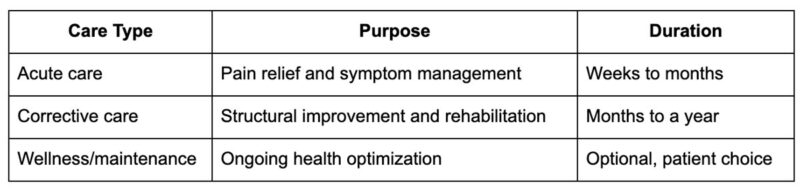
Patient choice and goals: You decide your treatment goals. Some patients come for acute pain relief and stop once they feel better. Others choose ongoing maintenance care because they value the preventative benefits. Neither choice is wrong – it’s about what works for your health goals and lifestyle.
Myth #8: Chiropractic Is Not Safe for Children or Older Adults
Age is not a barrier to safe chiropractic care – technique adaptation is key.
Age-appropriate techniques: Adjustments for infants use no more pressure than you’d use to test the ripeness of a tomato. For older adults with osteoporosis or arthritis, we use modified, low-force techniques specifically designed for fragile bones.
Focus on function, not force: Effective chiropractic care matches the technique to the patient. We never use a one-size-fits-all approach, especially with vulnerable populations like children and seniors.
Final Thoughts
The misconceptions about chiropractic care often prevent people from exploring treatment that could genuinely help them. After two decades in practice, I’ve seen countless patients delay care because of myths that simply aren’t true.
You deserve accurate information. You deserve to ask questions without judgment. And you deserve healthcare that respects both your concerns and your intelligence.
At Chiropractic Care Centre in Tampa, FL, we encourage skepticism because informed patients make the best healthcare decisions. We’re here to provide honest answers, explain our approach clearly, and help you determine whether chiropractic care is right for you.
Have questions we didn’t cover here?
- Visit Chiropractic Care Centre in Tampa, FL
- Call today to schedule a no-pressure consultation
Good healthcare starts with good information. We’re here to provide both.