
Stages of Herniated Disc Recovery: What to Expect During Healing

The stages of herniated disc recovery often involve gradual pain relief, improved movement, and a return to daily activities. Many people feel better within a few weeks, although recovery can take several months.
At Chiropractic Care Centre, we help patients understand their symptoms and explore appropriate care options. Knowing what to expect during recovery can help you recognize signs of improvement and when to seek medical attention.
Understanding how a herniated disc heals
A herniated disc occurs when the soft inner material of a spinal disc pushes through its outer layer. This can irritate nearby nerves, causing pain, numbness, tingling, or weakness.
Your body may recover through several natural processes:
- Reduced inflammation: Irritation around the affected nerve gradually decreases.
- Natural disc resorption: Your immune system may absorb some of the herniated disc material.
- Reduced nerve pressure: As inflammation decreases or disc material shrinks, nerve symptoms may improve.
- Improved movement: Less pain makes daily activities easier.
However, feeling better does not always mean the disc has completely healed.
The 4 stages of herniated disc recovery
Herniated disc recovery often follows four general phases. However, the timeline varies depending on your symptoms, nerve involvement, and overall health.
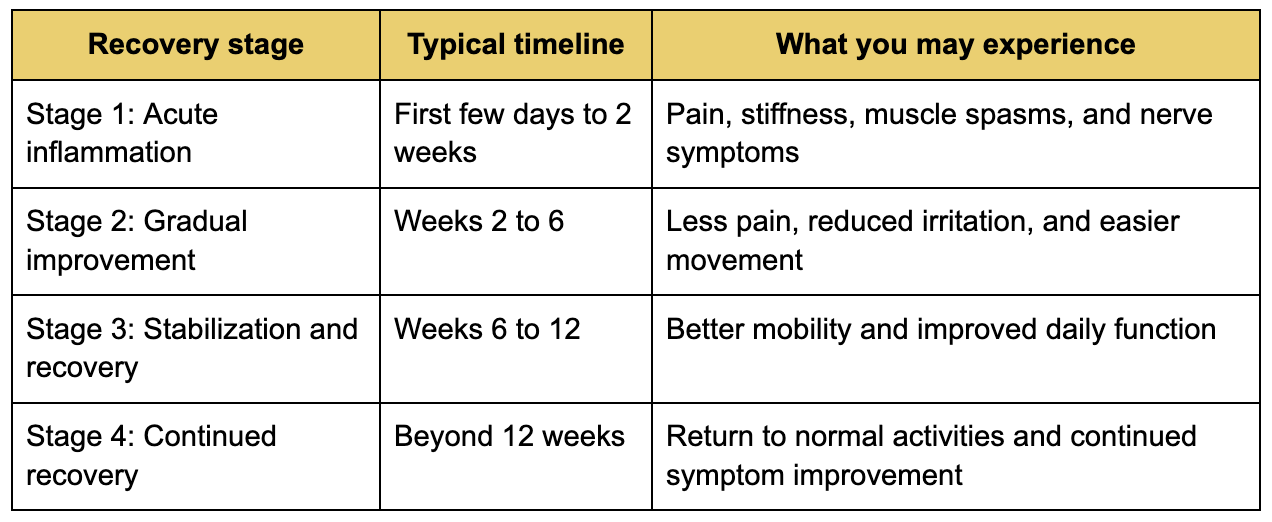
These are general recovery patterns, not fixed medical stages. Some people improve sooner, while others need several months.
Stage 1. Acute inflammation
Typical timeline: First few days to 2 weeks
The early stage often involves the most noticeable pain. A herniated disc may irritate nearby nerves, causing inflammation and muscle tension.
Common symptoms include:
- Sharp or aching back or neck pain.
- Pain traveling into the leg or arm.
- Muscle spasms and stiffness.
- Difficulty sitting, bending, or changing positions.
During this stage, focus on managing symptoms and avoiding activities that worsen pain. Gentle movement is generally preferable to prolonged bed rest.
Stage 2. Gradual improvement
Typical timeline: Weeks 2 to 6
As inflammation decreases, pain may become less intense or occur less frequently.
You may notice that walking, standing, or changing positions feels easier. Pain traveling down your leg or arm may also decrease, although numbness or tingling can remain.
Gradually increasing comfortable movement and following appropriate rehabilitation guidance may support recovery.
Stage 3. Stabilization and recovery
Typical timeline: Weeks 6 to 12
During this stage, many people notice further improvements in mobility and daily function.
You may find it easier to walk longer distances, sit comfortably, and return to routine activities.
Occasional stiffness or discomfort may still occur, especially after prolonged sitting or physical activity.
Rehabilitation may focus on improving strength, flexibility, and movement without aggravating symptoms.
Stage 4. Continued recovery
Typical timeline: Beyond 12 weeks
Many people have returned to most normal activities by this stage. However, recovery may continue for several months, particularly when nerves have been affected.
Some numbness, stiffness, or occasional discomfort may remain.
Regular movement, appropriate strengthening exercises, and healthy daily habits can help maintain function. Persistent or worsening symptoms should be evaluated.
Signs your herniated disc is healing
Improvement usually happens gradually. Common signs of herniated disc recovery include:
- Less frequent or intense pain: Discomfort becomes milder or occurs less often.
- Reduced radiating pain: Pain traveling down your leg or arm gradually decreases.
- Pain centralization: Pain that previously traveled down your leg moves closer to your lower back. This can be a positive sign in some cases.
- Less numbness or tingling: Nerve related sensations become less noticeable.
- Improved mobility: Walking, bending, and changing positions become easier.
- Better sleep and daily function: You can rest and complete daily activities more comfortably.
Symptoms may fluctuate during recovery. An occasional painful day does not necessarily mean your condition is worsening.
However, symptom improvement alone cannot confirm that the disc has completely healed.
What affects herniated disc recovery time?
Several factors can influence how quickly your symptoms improve:
- Severity of the herniation: More significant disc problems may cause longer lasting symptoms.
- Disc location: Herniated discs in the neck and lower back affect different nerves and movements.
- Nerve involvement: Persistent numbness or weakness may require additional recovery time.
- Daily activities: Heavy lifting, repeated bending, or prolonged sitting may aggravate symptoms.
- Overall health and treatment: Your health and response to appropriate care can influence recovery.
The size of a herniated disc does not always determine how much pain you experience.
How to support herniated disc recovery
Certain habits and treatments may help manage symptoms and improve mobility during recovery.
Stay active with gentle movement
Short walks and comfortable exercises can help maintain mobility. Avoid prolonged bed rest and gradually increase activity as your symptoms allow.
Stop movements that cause worsening pain, numbness, or weakness.
Reduce strain on your spine
Small adjustments to daily activities may help:
- Change positions regularly.
- Avoid heavy lifting or repeated bending when painful.
- Use supportive seating.
- Choose comfortable sleeping positions.
Finding suitable sleeping positions for a herniated disc may also help reduce nighttime discomfort.
Follow an appropriate treatment plan
Physical therapy and rehabilitation exercises may help improve strength and movement.
For selected patients, chiropractic care or spinal decompression may be considered as part of a treatment plan. However, these approaches should not be assumed to speed up disc healing.
A professional evaluation can help determine which options are appropriate for your symptoms.
When to seek medical care during recovery
Although many herniated discs improve without surgery, certain symptoms require medical attention.
Schedule a medical evaluation if you experience:
- Pain that continues without improvement.
- Increasing numbness or tingling.
- New muscle weakness.
- Symptoms that significantly limit daily activities.
Seek emergency medical care immediately if you experience:
- Loss of bladder or bowel control: New difficulty controlling urination or bowel movements.
- Saddle numbness: Reduced sensation around your groin or inner thighs.
- Severe or rapidly worsening leg weakness: Sudden difficulty lifting your foot or walking.
These symptoms may indicate serious nerve compression requiring emergency evaluation.
Supporting your recovery at Chiropractic Care Centre
Herniated disc recovery takes time, and understanding your symptoms can help you make informed decisions about your care.
At Chiropractic Care Centre, we evaluate your spinal health and movement before recommending appropriate treatment options, which may include chiropractic care and spinal decompression.
If you are experiencing ongoing symptoms, contact us to schedule an evaluation and discuss your care options.
Frequently asked questions about herniated disc recovery
How long does a herniated disc take to heal?
Many people improve within 6 to 12 weeks. However, some symptoms may take several months to resolve.
Can a herniated disc heal on its own without surgery?
Yes. Many herniated discs improve naturally as inflammation decreases and the body absorbs some displaced disc material.
How do you know if a herniated disc is getting better?
Signs include less pain, reduced numbness or tingling, improved mobility, and greater comfort during daily activities.
Is it normal for herniated disc pain to come and go during recovery?
Yes. Pain may fluctuate during recovery. However, worsening symptoms or new weakness should be evaluated.
Can a herniated disc get worse while healing?
Yes. Symptoms can worsen if nerve irritation increases. Persistent or worsening pain, numbness, or weakness requires medical assessment.